
THE FAMILIAR MADE STRANGE
Where the Mojave Desert is today there once existed an ocean.
Standing in the place today, surrounded by Joshua trees, granite outcroppings, and distant snow-capped mountains, this can be difficult to imagine. Yet the evidence is everywhere. Ancient seabeds, marine fossils, and time-worn geology remain scattered across a landscape now defined by seasonal drought.
The desert is a place of contradictions. Sand and snow. Flood and drought. Life and desolation. Perhaps that is why sea sponges never felt entirely out of place here.
When I first moved to the High Desert, I was fascinated by the fallen remains of Joshua trees. Weather, sunlight, and time transformed their trunks into strange porous forms. The wood became fibrous and skeletal. Branches took on the appearance of coral, bleached bone, or something altogether otherworldly.
Walking through the desert, I found myself thinking less about trees and more about the ocean. The resemblance was impossible to ignore.
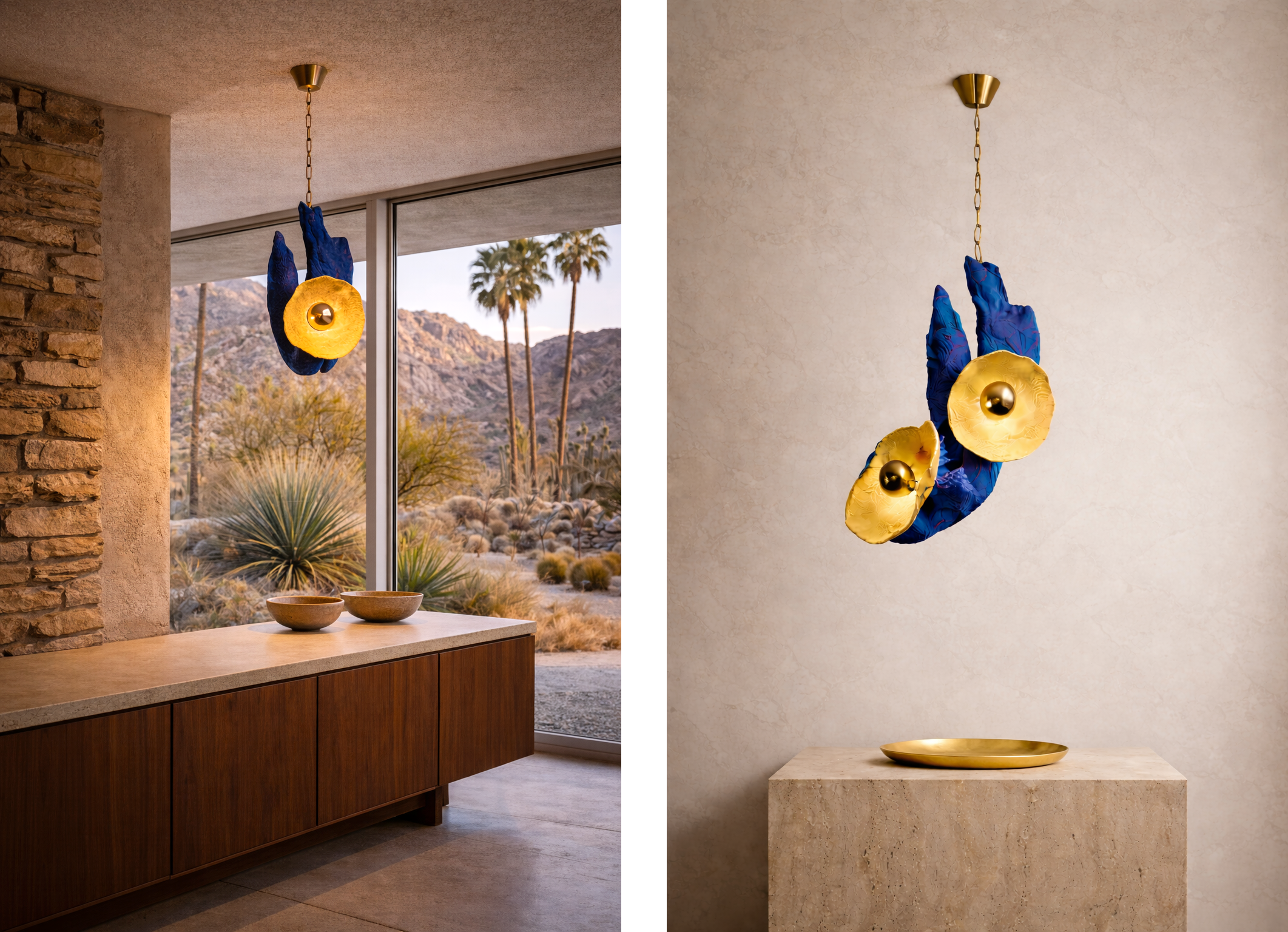
SEEP PENDANT
powder-coated bronze-cast wood burl & gold-plated sea sponge, chain, 2023, 19.5 x 12 x 7 in.
SPILL PENDANT
powder-coated bronze-cast wood burl & gold-plated sea sponge, chain, 2023, 19.5 x 12 x 7 in.
A sea sponge and a weathered Joshua tree branch seemed to occupy the same bizarre planet. One born of the ocean; the other of the desert. Both shaped by forces larger than themselves.
Both are records of time.
The sponge is shaped by currents, tides, growth, and erosion; the Joshua tree by drought, gravity, wind, and decay. Neither object is static. Each bears the memory of the environment that formed it.
That memory fascinated me.
Sea sponges have appeared throughout the history of art and design. Yves Klein, Marcel Wanders, and many others recognized their peculiar ability to exist somewhere between nature and artifice. I was hardly the first person to notice them.
What interested me was something else. Not preservation: transformation.
The sea sponge is a remarkable structure. It adapts. It absorbs. It evolves. Its form is not imposed but shaped by the environment in which it lives. Currents, pressure, growth, and time continually modify its geometry.
The object changes. Its nature does not. That observation eventually became the foundation for a series of experiments.
The sponges were strengthened, cast, metal-plated, assembled, and combined with other found forms. Weathered Joshua tree remnants were digitally documented in the field and translated into cast elements. The resulting works gradually evolved into lamps, sculptures, shadow pieces, and objects that resisted easy classification.
What emerged surprised me. The castings did not lose their identity. They became something else while remaining unmistakably themselves.
The intricate structure remained intact. The porosity permanent. Even during the plating process, the cast forms continued to behave like sponges, retaining solutions and producing unexpected chemical reactions across their surfaces. The memory of the original object persisted through every transformation.
The sponge remained a sponge.
At first glance the pieces appear decorative, but I have always thought of them more as fine sculptures. As something closer to a floral arrangement than a conventional light fixture. As forms gathered together and momentarily held in equilibrium.
A sponge.
A burl.
A branch.
A cast.
A trace.
An artifact.
An erg. …
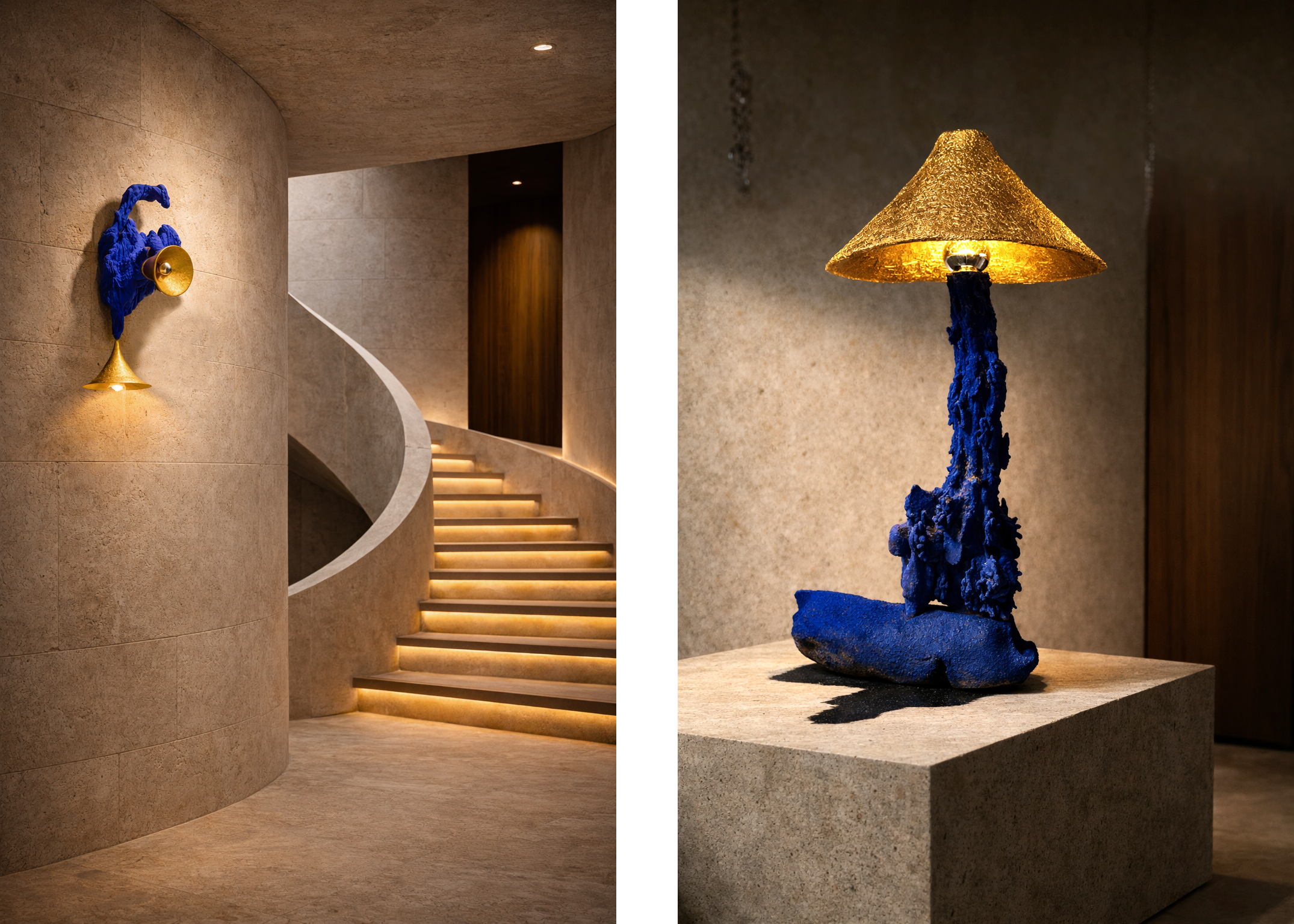
BRANCH SCONCE
powder-coated bronze-cast wood burl & gold-plated sea sponge, bracket, 2023, 14.5 x 9 x 5.5 in.
WICK TABLE LAMP
powder-coated bronze-cast wood burl & gold-plated sea sponge, steel plate, cloth-covered cord, 2023, 14 x 12 x 22 in.
When I first saw the finished pieces, I was dazzled by their evocations. The composition matters as much as the individual parts. The metallic surfaces amplified qualities that had always been present. Light moved across thousands of tiny cavities and crystalline edges. The objects felt geological, biological, architectural, and extraterrestrial all at once.
The gold pieces flickered like candles.
The blue pieces seemed to disappear altogether, leaving only floating forms suspended in darkness.
Perhaps this is why the collection eventually took the name Oumuamua.
Like the interstellar object that briefly passed through our solar system, the pieces felt oddly displaced—a message from a distant galaxy. Familiar enough to recognize, yet strange enough to resist explanation.
The desert was once an ocean. That idea never entirely left me. Even now, when I walk through the landscape, most of what I encounter is simply debris. Fallen branches. Fragments. Litter.
But every so often a form becomes visible. A section remains intact. The erosion is evident. Time has been kind. Something essential survives.
Those are the moments that interest me. Not invention. Not imitation. Recognition.
The discovery of forms that have endured long enough for their essential qualities to emerge.
The sea sponge become bronze. The bronze become gold.
The gold become light.
Yet none of these transformations erase the memory of what came before.
-Micah
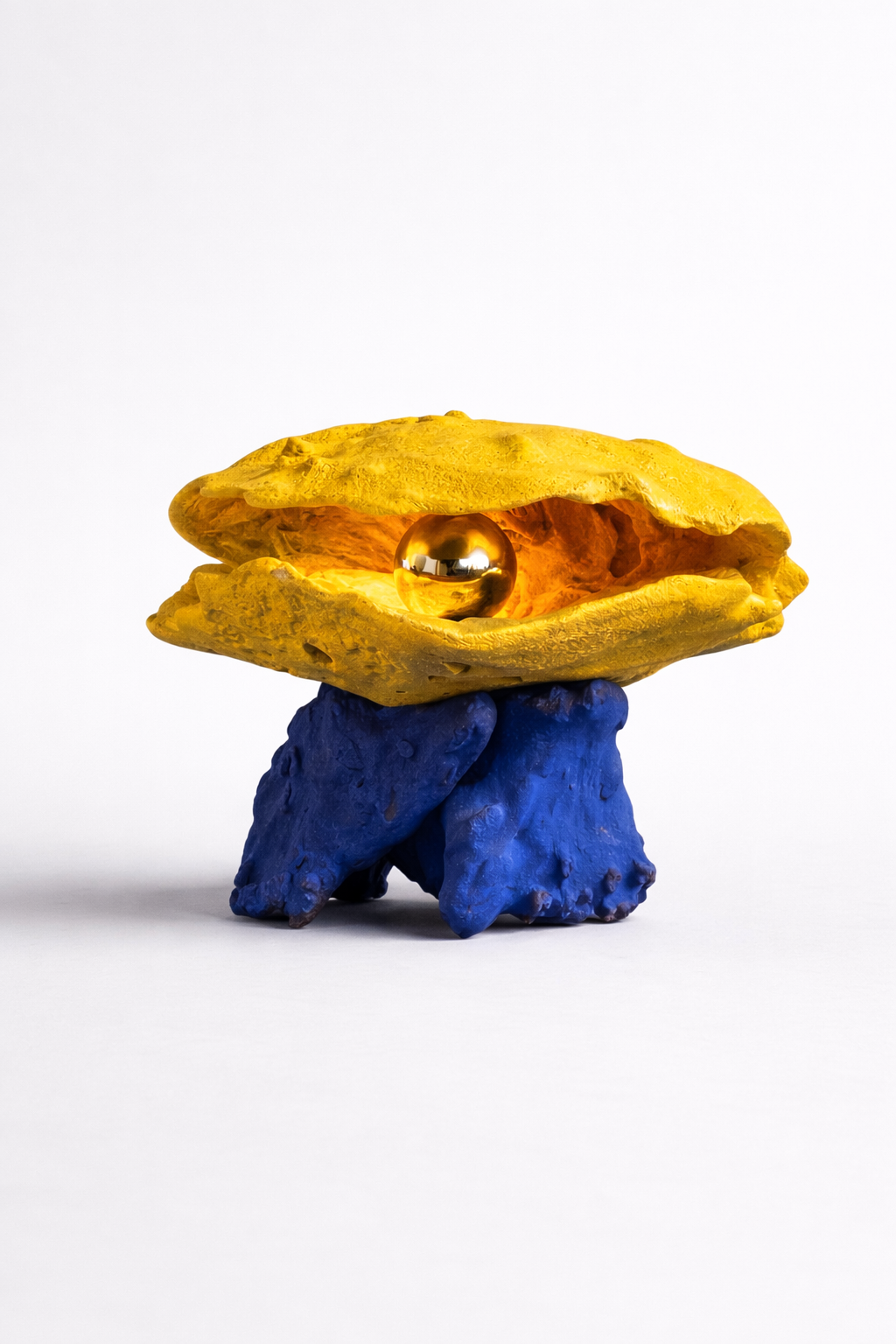
PUDDLE TABLE LAMP
Table lamp (single gold-dome bulb), powder-coated bronze-cast wood burl & gold-plated sea sponge, cloth-covered cord, 2023, 12 x 8 x 8 in.
