
THE SUPERSTATE OF GLASS
The first thing I ever knew about mica was that it has the capacity to sparkle. Difficult, seeing it rhymes with my name.
So, not in any profound way. Not in a natural way. Certainly not in a way that suggested years of experimentation, patents, factories, or architectural applications. It sparkled, and that was enough.
Small flakes would appear in rocks, embedded in stone, scattered along trails, or suspended in the sand beneath my feet. They caught sunlight and returned it as frozen shafts of radiance. Every child understands this attraction instinctively. We pick up shiny things long before we learn their names.
Human beings have been captivated by mica for thousands of years. The Maya incorporated it into their sacred architecture. The Hopewell people carried it across vast distances and carved it into ceremonial objects. Ancient Hindu traditions associated its shimmering surface with lightning flashes. Across continents and centuries, people found themselves magnetically drawn to this strange mineral.
The fascination is difficult to explain.
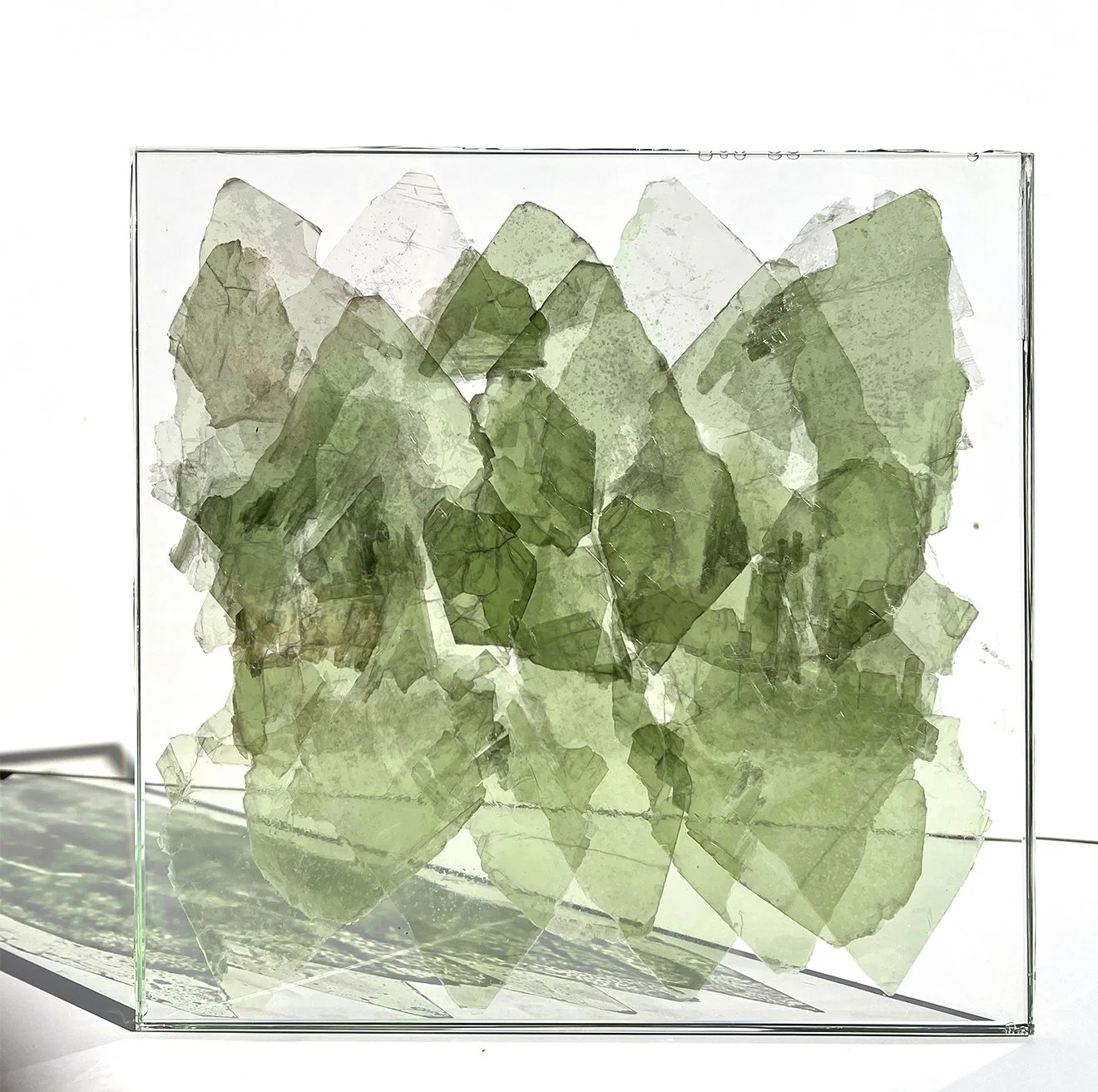
Jade green InterMica Glass
Mica occupies an indeterminate terrain. It is neither stone nor mirror, neither transparent nor translucent. It captures light, reflects it, scatters it, and seems to change direction as the observer moves. It possesses a quality that designers often struggle to describe but instantly recognize. it appears alive.
Perhaps that is why it has endured despite itself.
Unlike precious gemstones or rare minerals, mica is remarkably common. It appears in paints, electronics, insulation, cosmetics, and countless industrial products. Designers regularly refer to its qualities for colors, finishes, and textures where they are meant to suggest luminosity and depth.
The irony is that, after eons of ceremonial prominence, mica is now rarely allowed to take center stage. It tends to remain hidden beneath the surface, buried within assemblies, reduced to an ingredient rather than the main attraction.
That never seemed entirely fair. I decided to do something about it.
Years ago, while working in a studio in downtown Los Angeles, I found myself staring at two unrelated objects resting near one another: a beveled piece of glass and a loose material from a bag of mica flakes.
The observation was almost embarrassingly simple. Yet it lingered.
What would happen if the mica became part of the glass?
The question took root, and then refused to leave.
Over the following years, the idea evolved through countless experiments, failures, and revisions. Mica is beautiful precisely because it is delicate. Large crystals fracture. Thin sheets crumble. The qualities that make it fascinating are often the very qualities that prevent its use in architecture.
Yet the contradiction itself became interesting.
Mica is often quite fragile. Architectural glass is not—or is not meant to be.
A crystal can fracture beneath the pressure of a careless hand. Tempered glass can withstand forces that would destroy the mineral under similar circumstances. One material is geological, ancient, and irregular. The other is industrial, engineered, and preferably exacting.
Bringing them together was less a matter of decoration than reconciliation.
Eventually, after years of trial and error in collaboration with industrial glass fabricators, the solution for producing the material at architectural scale was reached.
What emerged was not simply glass containing mica. It was something else entirely.
Modern architecture has largely reduced glass to its foremost task: the transparent interface between here and there. We celebrate it when it is not seen. We praise it when it merges with the exterior. The ideal pane is often considered the one we notice least.
Yet transparency is only one of glass's many qualities.
Glass reflects. It refracts. It distorts. It captures light. It records weather. It protects. It changes with the season and time of day. A pane of glass can be as atmospheric as water, as luminous as a cloud, or as mysterious as a shadow.
InterMica began as an exploration of the iridescence of nature.
Within the laminated assembly, mica remains suspended between layers of glass like fragments of geological time. Light passes through portions of the material, reflects from others, and scatters across countless internal surfaces before returning altered. Depending on the angle of observation, the glass may appear translucent, reflective, opaque, crystalline, metallic, or softly illuminated from within.
No single description is sufficient. The material exists in multiple states simultaneously.
I began thinking of it as a superstate of glass. Not a scientific term. A perceptual one.
Someone simply had to recognize it.
-Micah
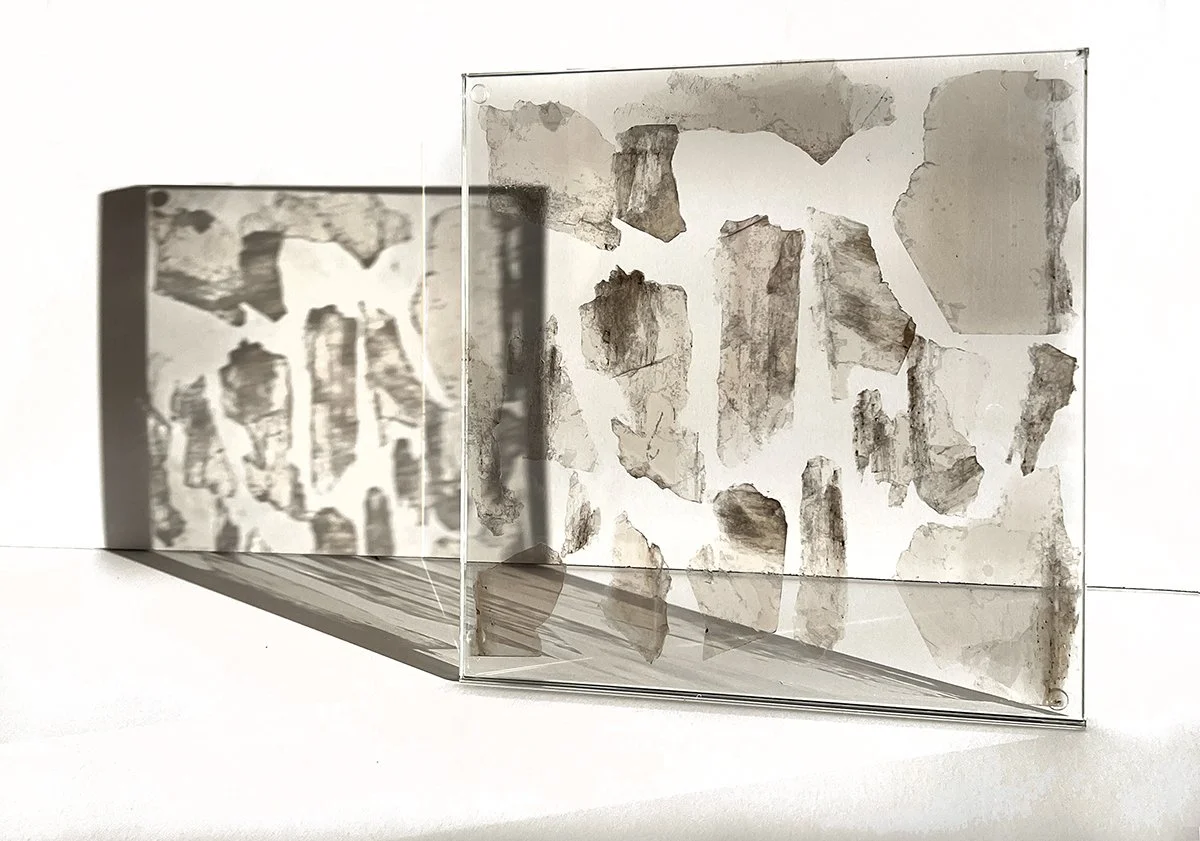
Amber InterMica Glass
