
MINERAL PAINTING
Nature's oldest paintings were never painted.
Long before artists ground pigments or stretched canvas, the earth had already begun composing images. Mineral veins wandered through stone. Sediment settled into improbable landscapes. Heat, pressure, gravity, and time produced surfaces so deliberate they seem almost intentional, though no hand arranged them.
Perhaps that is why polished onyx feels so captivating; why an opal appears to change its mind every time it catches the light; why people have collected stones for thousands of years for no other reason than wonder.
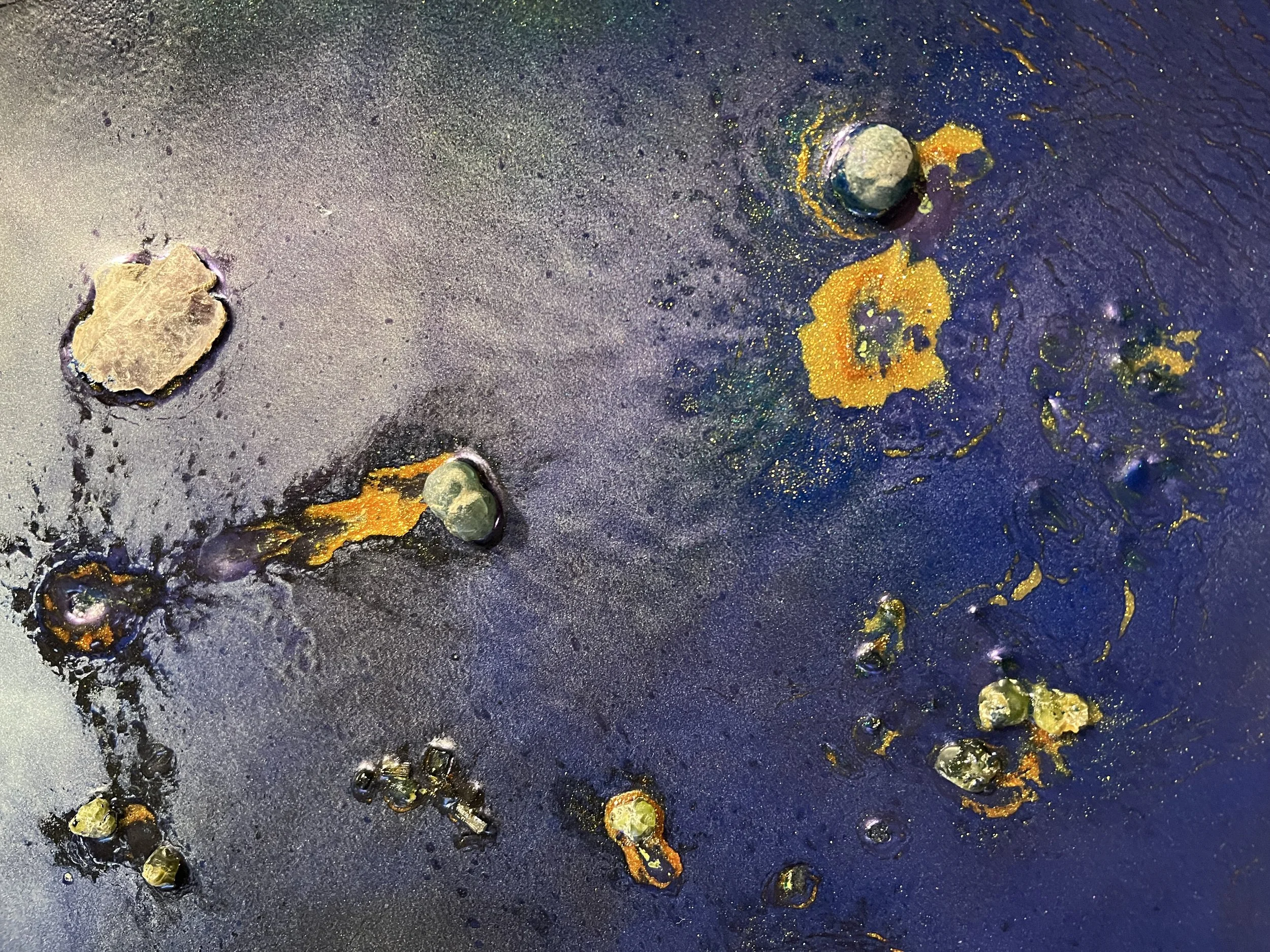
OORT CLOUD — UV, 2024, mica panels, semi-precious gemstones, mica powder & applied color powder coating on lampshade mica sheet, 48 x 48 x .5 in. (9-panel grid 16 x 16 in. each) mounted in matte white aluminum frame. https://www.furbishure.com/book-of-mica/p/oort-cloud
See more at https://www.bookofmica.com/
For years, mica has been central in my work. Whether as architectural glass, furniture, lighting, cladding, or interiors, the mineral produces unrepeatable yet controllable finishes far beyond the techniques of plating, anodizing, or polishing.
Now, with the recent introduction of powder coating, mica has evolved to an entirely new level.
Instead of treating this powder as a finish, it becomes a transformative medium. Layers of translucent pigment, instead of burying mica beneath the surface, carry it further into prominence.
Ground gemstones occasionally resurface, more often disappearing into later firings, leaving only traces of their passage. The compositions became less about arranging materials and more about watching them interact. The paintings no longer resembled painted surfaces per se. They began behaving like real geological formations.
Just like the Earth's inner core, the transformation happens inside an oven. At nearly five hundred degrees, certainty begins to loosen its grip. Powder softens. Chemistry reorganizes the surface. Gravity, along with adhesion and cohesion, gathers material into edges and pools. Minerals recrystallize according to their own nature. The firing is not just preserving the work. It is actively participating in its formation.
Heat. Gravity. Chemistry. Subduction. Time. All compressed into a single firing.
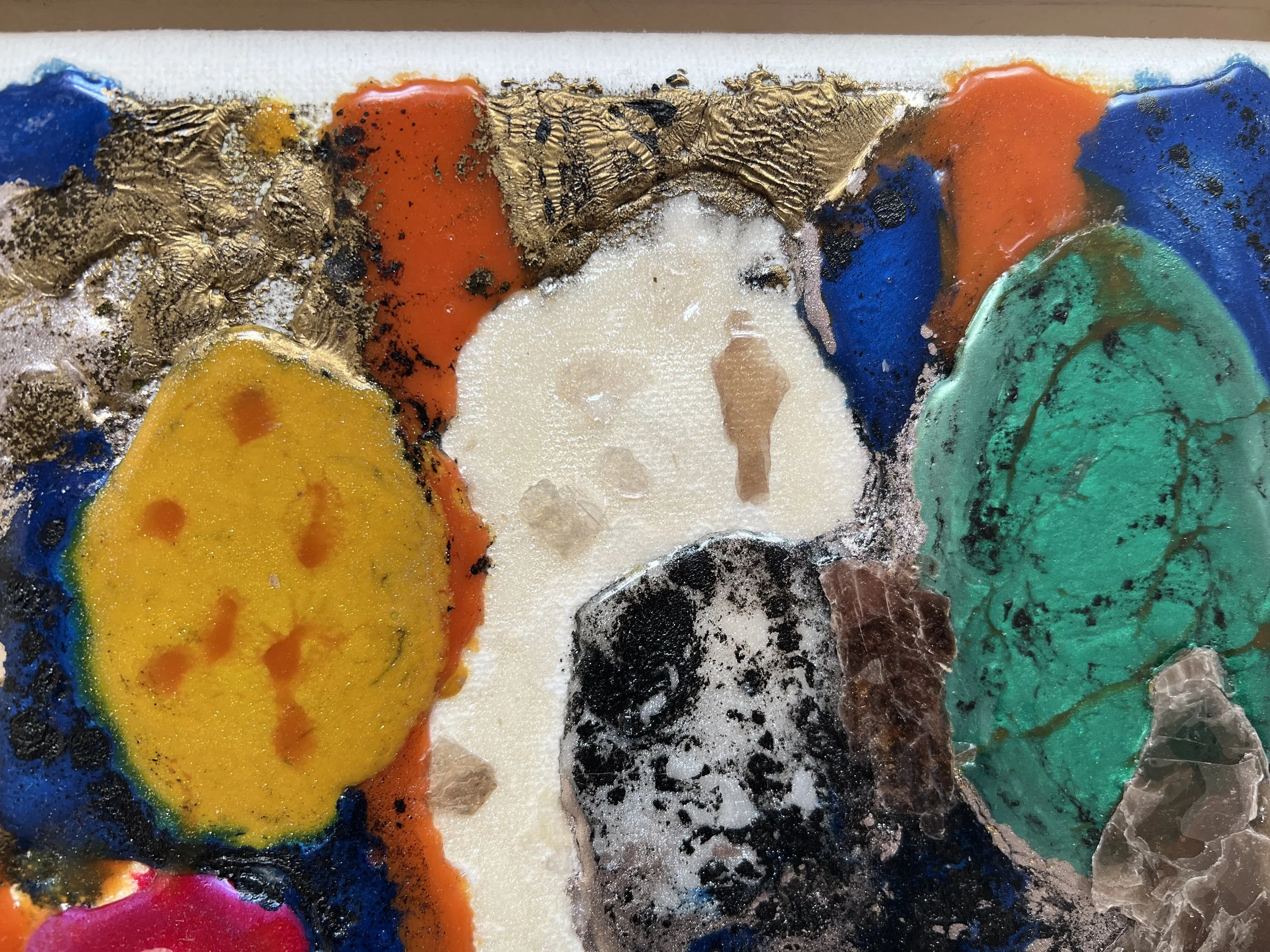
GROSS PEARLS #11, 2022, mica panels & applied color powder coating on ceramic fiber paper, 12 x 12 x .5 in.
Architecture often celebrates predictability. Drawings locate every wall, align every opening, and describe every joint with minute precision. Yet some of the most rewarding moments in design occur when the designer stops trying to determine every outcome and instead constructs the conditions under which something unexpected can emerge.
Old emerges as new. For instance, the steel packing straps, which began as temporary molds, may eventually become permanent frames. Never intended to resemble nineteenth-century mirrors, their outlines already anticipated it.
Different materials, under different working constraints, may often yield remarkably similar surprises.
Nature has been solving design problems for far longer than we have.
Design is not simply the act of imposing form onto matter. It is to submit the work to the same forces that created it.
— Micah Heimlich
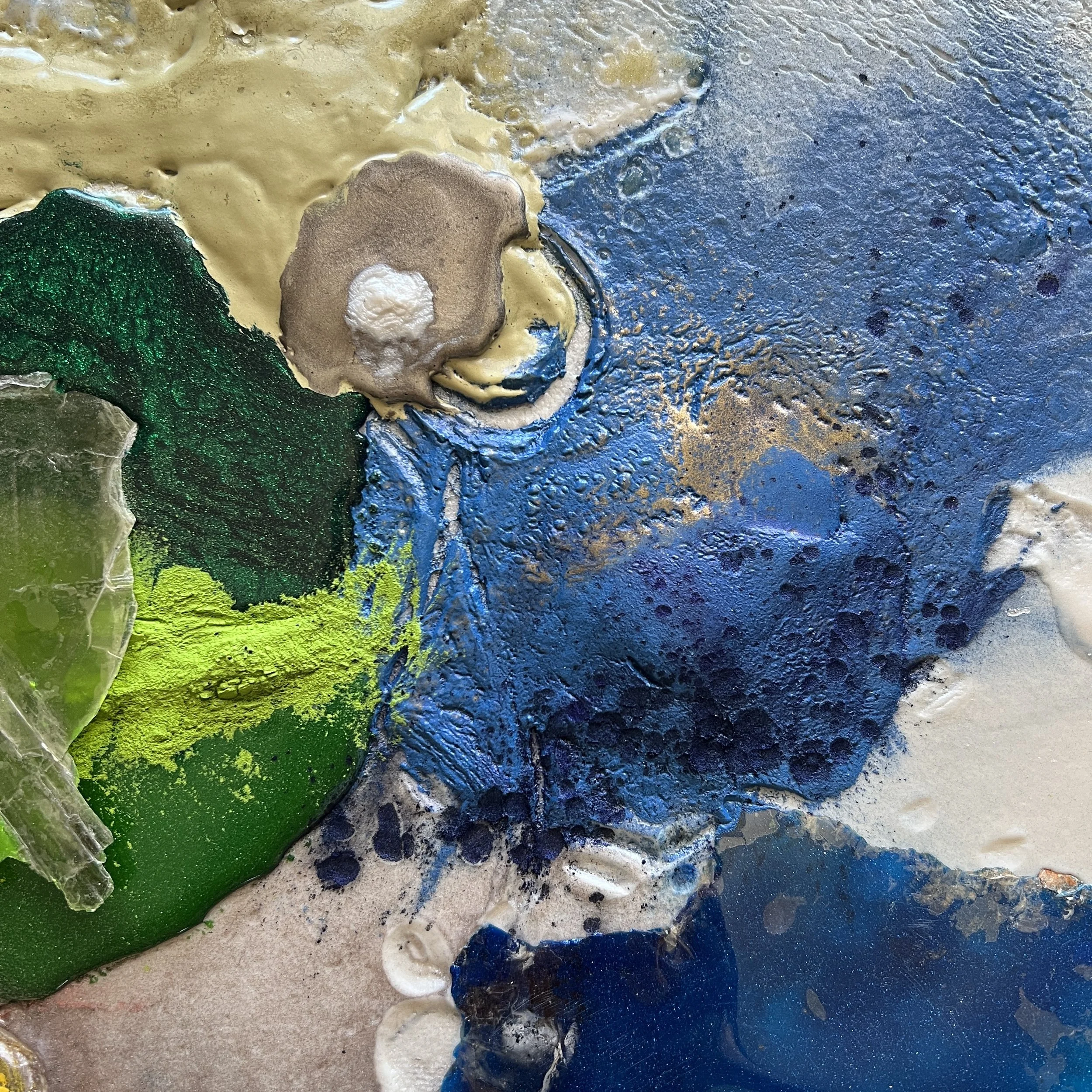
YELLOWSTONE, 2023, mica panels, mica powder & applied color powder coating on ceramic fiber paper, 24 x 24 x .5 in. mounted in maple floater frame. https://www.furbishure.com/book-of-mica/p/yellowstone
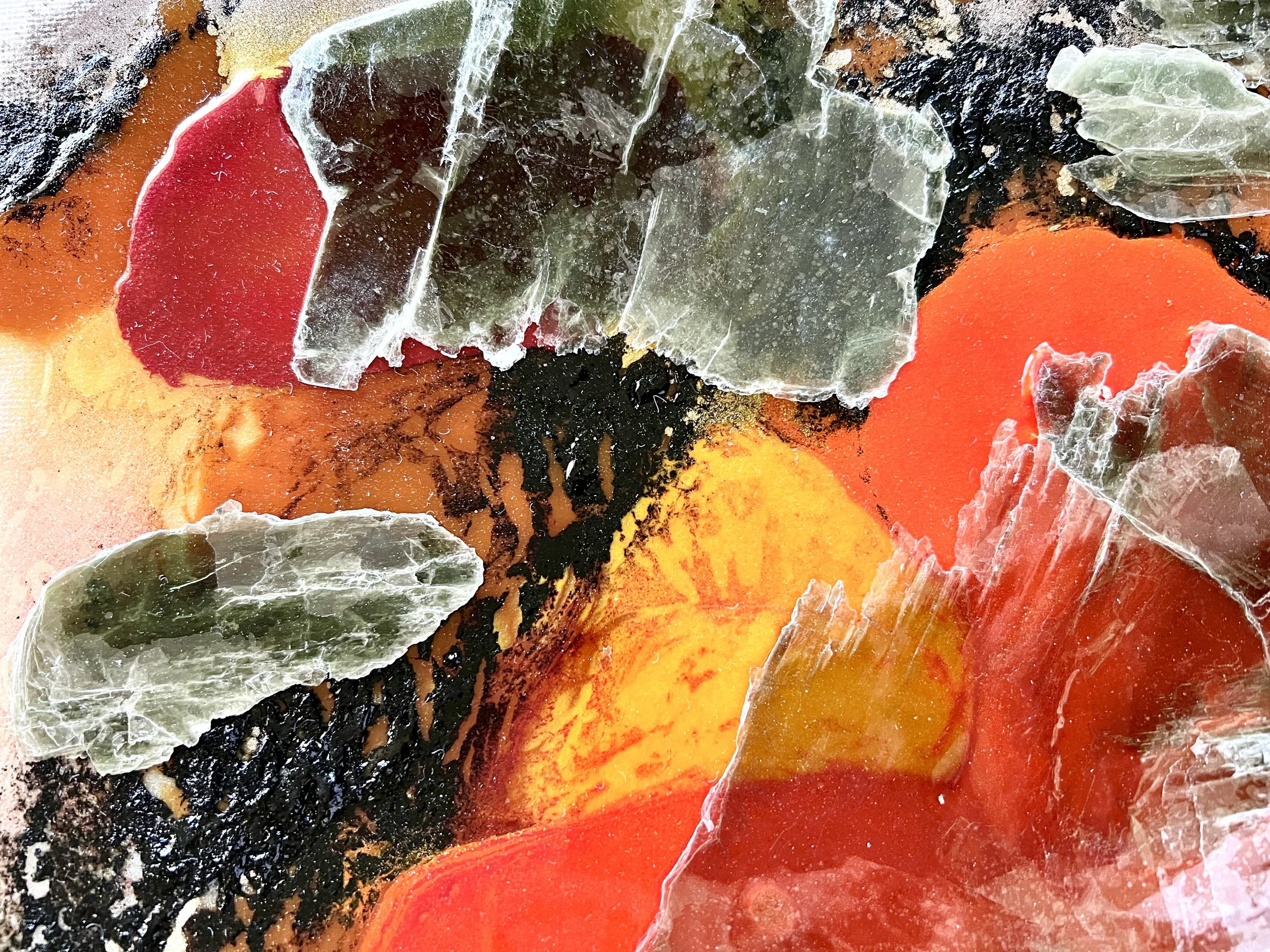
GROSS PEARLS #2, 2022, mica panels & applied color powder coating on ceramic fiber paper, 12 x 12 x .5 in. in contemporary maple frame. https://www.furbishure.com/book-of-mica/p/style-01-ej5na-mc4ea
Further reading on stones as images
→ Marina Warner, “The Writing of Stones,” in Cabinet.
→ https://iucat.iu.edu/iub/1534009
