THE SURFACE IS NOT SUPERFICIAL
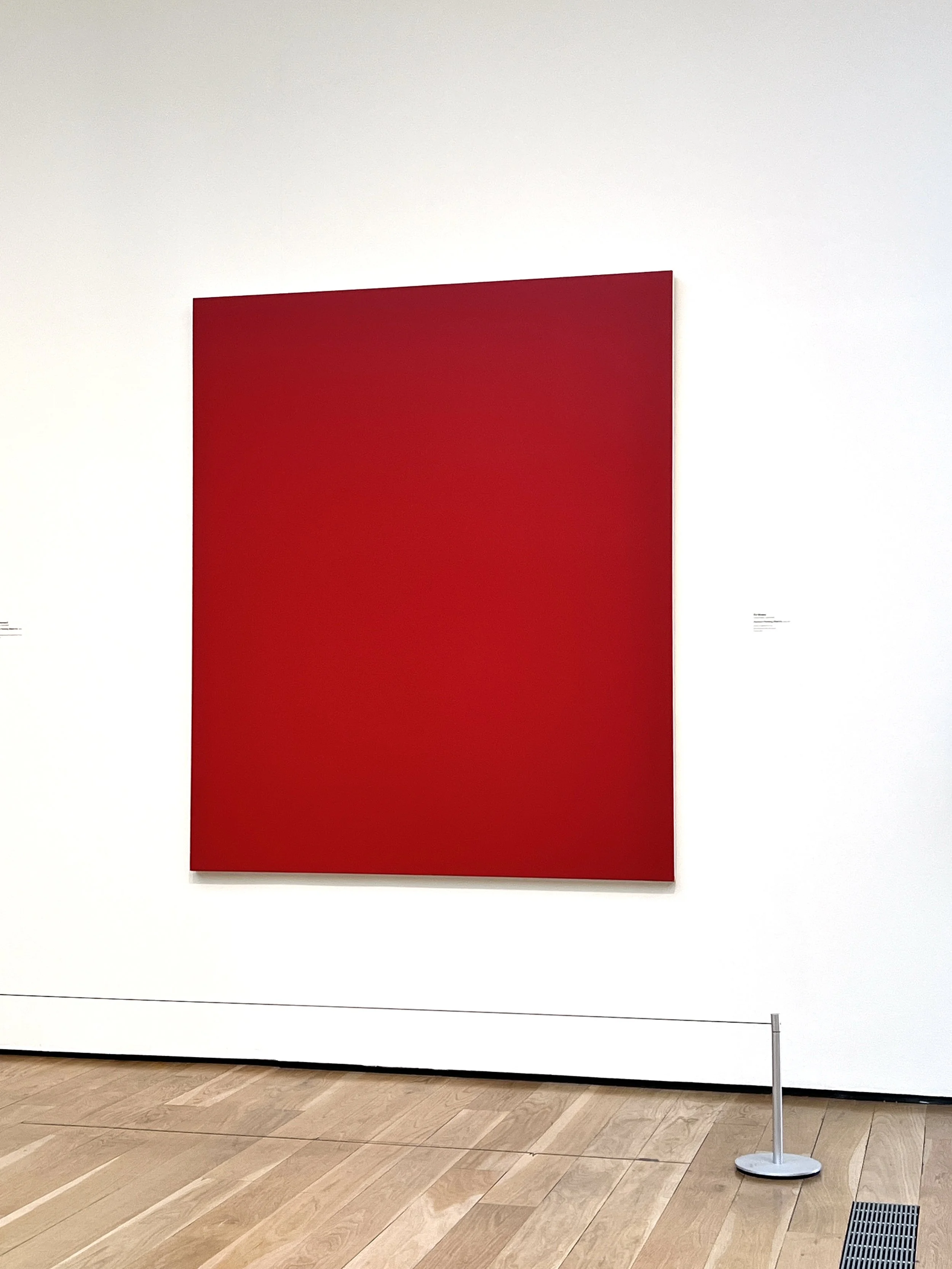
At LACMA several weeks ago, I encountered a red painting by Ed Moses. Its significance did not immediately strike me. An abstract square, apparently without image or incident—a nearly unbroken flat field of crimson.
But the closer I looked, the less settled it became. Light gathered unevenly across its surface. Some portions absorbed it; others returned it with a renewed brilliance. The painting became legible without diminishing what the experience of seeing beyond it had promised.
Recognition was instantaneous. Perception was not. What held me was luster.
Luster is not another image laid upon an object. It is the material’s way of handling light. A lustrous surface brightens, recedes, and changes according to the position of the light and of the person standing before it. The object remains still, even though the act of seeing this requires movement.
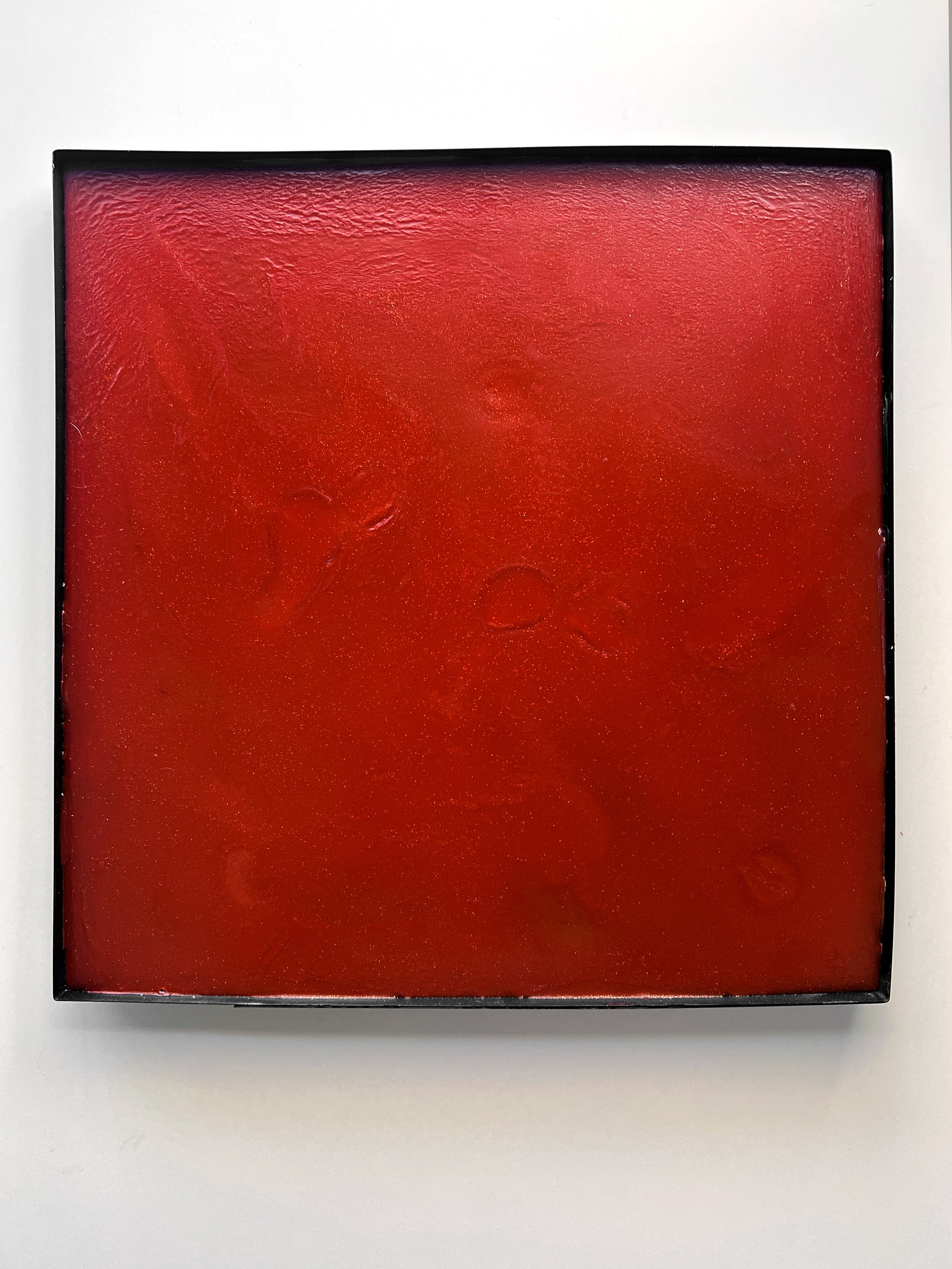
The Great Unconformity, 2026, mica powder & applied color powder coating, steel, 14 × 14 inches.
This is especially apparent in chatoyant materials. A flash emerges, travels across the surface, and disappears. To recover it, the observer must move. Back and forth, no longer rooted to the spot.
The material cannot be fully perceived from a single position because its appearance belongs not to the object alone, but to a physical relationship between matter, light, and experience.
Luster makes us conscious of material as material.
Surface is often treated as something secondary or nonessential: an outer layer applied to the more substantial matter beneath it. Yet material reaches us through its surface. A brushstroke records the movement that applied the paint. Patina records exposure, handling, time. Texture resists the tension of the hand—or causes the eye to anticipate that tension.
Luster reveals what light is doing to the material RIGHT NOW.
This is perhaps why I often think of Tiffany art glass. The luster refuses to disappear into the image the glass carries. The ripples, folds, opacities, iridescence, and peculiar luminosity are not merely surface effects laid over the image. They facilitate much of its work.
Glass has body. Its color possesses density. Light does not simply pass through it; light is caught, scattered, filtered, and released by the particular interchange between depth and surface.
Even without touching glass, one imagines its coolness, its smoothness—the drag of a fold beneath the fingertips. Looking becomes almost tactile.
Lust and luster are etymological strangers, but their accidental proximity feels pertinent. A lustrous surface produces desire: to approach it, to circle around it, perhaps even to touch it. The eye encounters something it wants the hand to confirm.
After seeing the Moses painting, I made a small red square in a material I developed and employ in my own work. It was not a reproduction or tribute. I wanted to test its proposition: to see whether the material of an ordinary red field went deeper than the surface itself.
My “surface” contains shiny passages, wrinkles, spots, changes in density, and other evidence of its circuitous formation. These are not pictorial events. They are phenomenological. The image can penetrate through, while the material continues to implode.
The same condition appears throughout the Book of Mica series. Mica might seem moot from one position and suddenly flash forth from another. A plane that appeared opaque suddenly becomes reflective. Subtle forms emerge, then disappear again beneath the exterior.
Such work resists reproduction. A photograph can preserve color and composition, but it fixes a single instant of a surface whose character lies rather in its mutability. It shows what the work looks like from one position alone. It cannot fully communicate the interfacial interaction.
The surface is not superficial.
It is where mutability makes itself known.
—Micah Heimlich